
Yes, tardigrades can survive space. In 2007, dried tardigrades spent ten days exposed to open space in low Earth orbit, and most of them came back alive. But tardigrades are not indestructible. Almost all of their survival records were set by animals that had dried out first, into a dormant state called a tun. Wide awake in water, a tardigrade can be killed by a warm day near 37 °C.
Here are the real numbers, how the water bear pulls it off, and where its limits are.
- Size: 0.1 to 1.5 millimetres long, most about half a millimetre.
- Species: about 1,500 known, and the count grows every year.
- Space: about 3,000 rode into orbit in 2007, and most survived ten days of vacuum and cosmic rays.
- Radiation: half of one species survived 5,000 grays. For a person, 2.5 to 5 grays is often fatal.
- Weak spot: awake in water, half die after a day at about 37 °C.
- Longest proven wait: 30.5 years frozen in moss, then revived.
What is a tardigrade?
Tardigrades, also called water bears or moss piglets, are tiny animals with eight stubby legs tipped with claws, a plump body and a mouth like a drinking straw. They live in moss, lichen, soil, ponds and the sea. Scientists have described about 1,500 species. A 2025 census counted 1,488 worldwide and 99 in Germany alone (University of Stuttgart).
The tun: how a water bear survives by drying out
When its home dries out, a tardigrade pulls in its legs, loses almost all of its water and shrinks into a dry barrel called a tun. In this state, known as anhydrobiosis (“life without water”), it is not quite alive and not quite dead. It simply waits. Add water and it can unfold and walk away.
Most of the famous records below were set by tuns. That detail is the key to the whole story, and headlines usually skip it.
Five tests: the water bear versus you
Pick a test to see how a dried water bear compares with you.
| Test | Dried water bear | You |
|---|---|---|
| Heat | Half survived an hour at 82.7 °C | A core temperature a few degrees above 37 °C is dangerous |
| Cold | Revived after cooling in liquid helium, close to absolute zero | A drop of a few degrees in core temperature is serious |
| Pressure | Survived about 6,000 atmospheres | The deepest ocean trench presses with about 1,100 atmospheres |
| Radiation | Half survived 5,000 grays | A whole-body dose of 2.5 to 5 grays is often fatal |
| Space | Most survived 10 days of vacuum and cosmic rays | Needs a spacesuit |
Heat. Dried tardigrades of the species Ramazzottius varieornatus survived an hour at 82.7 °C, with half of them alive afterwards (Neves et al. 2020). That is hot enough to cook an egg.
Cold. Tuns have been cooled in liquid helium, to within about a degree of absolute zero (around −272 °C), and revived when warmed (Erdmann & Kaczmarek 2017).
Pressure. In 1998, Japanese scientists squeezed tuns to 600 megapascals, about 6,000 atmospheres, and most survived. In a later test, dried tardigrades survived twice that pressure for 20 minutes, while wet, active ones were killed (Horikawa et al. 2009). For comparison, the bottom of the Challenger Deep, the deepest point in the ocean, presses with about 1,100 atmospheres.
Can tardigrades survive in space?
Yes, and they were the first animals shown to survive exposure to open space (ESA). In September 2007, about 3,000 dried tardigrades flew on the European FOTON-M3 mission. For ten days they sat outside the capsule in low Earth orbit, 258 to 281 kilometres up (CORDIS).
Most of them survived the vacuum and cosmic rays. The Sun's full ultraviolet light was far harsher, about 1,000 times stronger than at Earth's surface, and only a few came through that. Back on Earth, the survivors laid eggs that hatched (Jönsson et al. 2008). Watch it in The Animals That Survived Open Space.
How much radiation can a tardigrade survive?
For the species Milnesium tardigradum, the dose of gamma rays that kills half of the animals within two days is about 5,000 grays. For heavy-ion radiation it is about 6,200 grays (Horikawa et al. 2006). For a person, a whole-body dose of about 2.5 to 5 grays is often fatal (CDC). That makes the water bear more than a thousand times tougher. Slide the dose to compare.
| Whole-body dose | A person | A water bear (M. tardigradum) |
|---|---|---|
| About 1 gray | Radiation sickness is likely | Most survive |
| 2.5 to 5 grays | Often fatal | Most survive |
| Over 1,000 grays | Fatal | Most survive, but they become sterile |
| 5,000 grays | Fatal | Half die within two days |
Radiation is the one test where drying out does not matter. Wet, active tardigrades take radiation as well as dried ones, or slightly better. Even so, there is a cost: doses above about 1,000 grays leave them sterile. The Short How Much Radiation Can a Water Bear Take? puts the numbers side by side.
How do tardigrades survive? Glass and a DNA shield
Two discoveries explain part of the trick.
Cells that set like glass. In 2017, researchers found that as a tardigrade dries, it fills its cells with special proteins found only in tardigrades. As the water leaves, these proteins set into a glass-like solid that holds the cell's parts in place, like fruit in jelly, until water returns (Boothby et al. 2017). Without these proteins, tardigrades survive drying much less well. See it in The Water Bear's Glass Trick.
Dsup, the damage suppressor. Dsup is a protein that binds to DNA. When scientists added it to human cells growing in a dish, X-ray damage to their DNA dropped by about 40% (Hashimoto et al. 2016). Whether Dsup protects the living animal in the same way has not yet been shown directly. Only some tardigrades carry it, and as of 2024, scientists could not yet switch the gene off in tardigrades to test it (Anoud et al. 2024).
Are tardigrades indestructible?
No. An active tardigrade is surprisingly fragile. In the same study that found dried animals surviving 82.7 °C, half of the awake, wet ones died after 24 hours at just 37.1 °C (Neves et al. 2020). The authors called high temperature the water bear's “Achilles heel”. A warm day in a drying puddle can be enough. More in Water Bears Are Not Indestructible.
Tardigrades are not invincible. They are patient, and their real superpower is waiting until conditions improve.
How long can a tardigrade stay dormant?
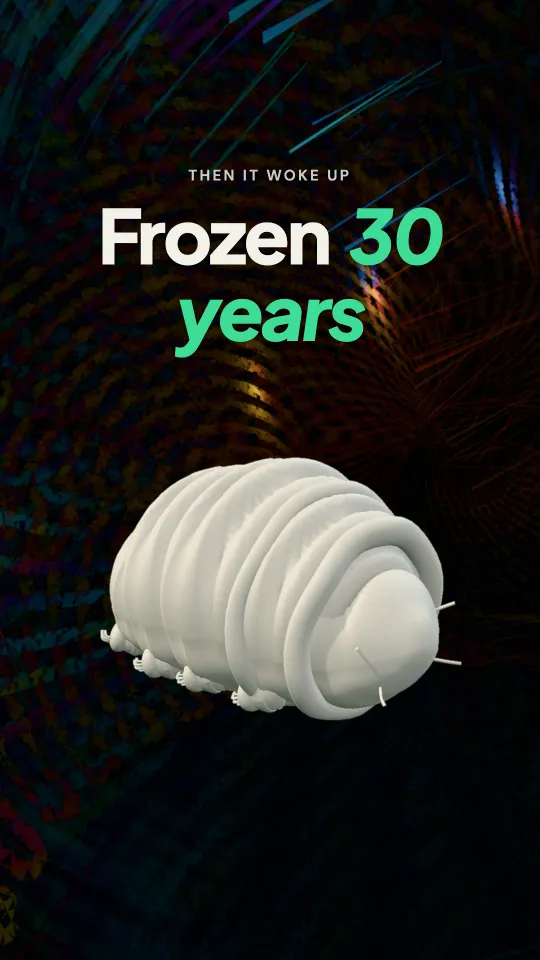
The best evidence is a moss sample collected in Antarctica in 1983 and kept frozen at −20 °C. After 30.5 years, scientists thawed it and revived tardigrades of the species Acutuncus antarcticus. They went on to reproduce (Tsujimoto, Imura & Kanda 2016).
You may read that dried tardigrades can wait a century. A 2001 look at the evidence found little support for it, and suggested a decade may be a more realistic upper limit for dried animals (Jönsson & Bertolani 2001). Watch Thirty Years Frozen, Then It Woke Up.
Frequently asked questions
Can tardigrades survive boiling water?
Not when awake. Half of active tardigrades die after a day at 37 °C, about the temperature of your body. Dried tuns are much tougher: half survived an hour at 82.7 °C, and reviews cite brief survival at around 150 °C for up to 15 minutes in dried animals.
Can a tardigrade survive in a vacuum?
Yes, when dried. In the 2007 space test, most dried tardigrades survived ten days of open-space vacuum and cosmic rays.
Are tardigrades really the toughest animals on Earth?
In the dried state, they hold some of the most extreme survival records of any animal: radiation, pressure, cold and open space. Awake, they are delicate, and a few degrees of warming can kill them.
Where can I find tardigrades?
Damp moss and lichen are the classic places to look, along with soil, ponds and the sea. They are common, but at about half a millimetre long you need a magnifier or a microscope to see one.