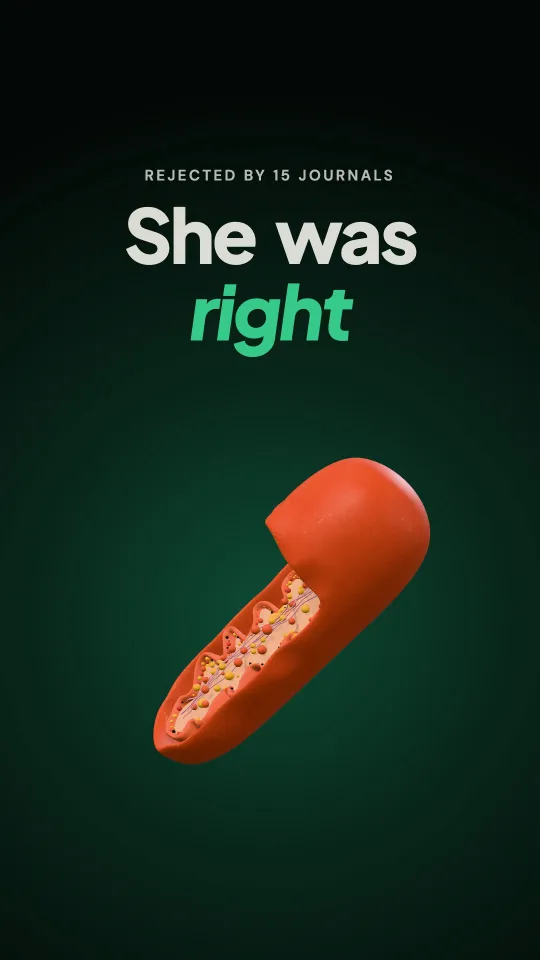
Mitochondria descend from bacteria. Somewhere between about 1.5 and 2 billion years ago, a bacterium ended up living inside another microbe, and instead of being digested, it stayed. Its descendants sit inside almost every cell in your body today. They still carry a little DNA of their own, and they still make most of the energy you run on.
Biologists call this endosymbiosis. The idea was rejected by journal after journal in the 1960s, and it is now in every biology textbook. Here is the evidence, the history, and what is still unknown.
- What they were: free-living bacteria. Their closest living relatives are the alphaproteobacteria.
- When they moved in: roughly 1.5 to 2 billion years ago. Dates vary between studies.
- Their own DNA: in humans, a ring of 16,569 base pairs carrying 37 genes.
- What they still make themselves: about 1,136 human proteins work inside mitochondria, and only 13 are made from mitochondrial DNA.
- Who you got yours from: almost always your mother.
What are mitochondria, and what do they do?
Mitochondria are small compartments inside your cells, wrapped in two membranes. A typical one is roughly one micrometre wide and two long, about the size of an E. coli bacterium (Milo & Phillips).
Their main job is to power the cell. They use the food you eat and the oxygen you breathe to make ATP, the small molecule every cell spends as energy. How many a cell holds depends on how much energy it needs. A careful count in rat liver cells found about 1,665 mitochondria per cell (Weibel et al. 1969). Your mature red blood cells have none at all.
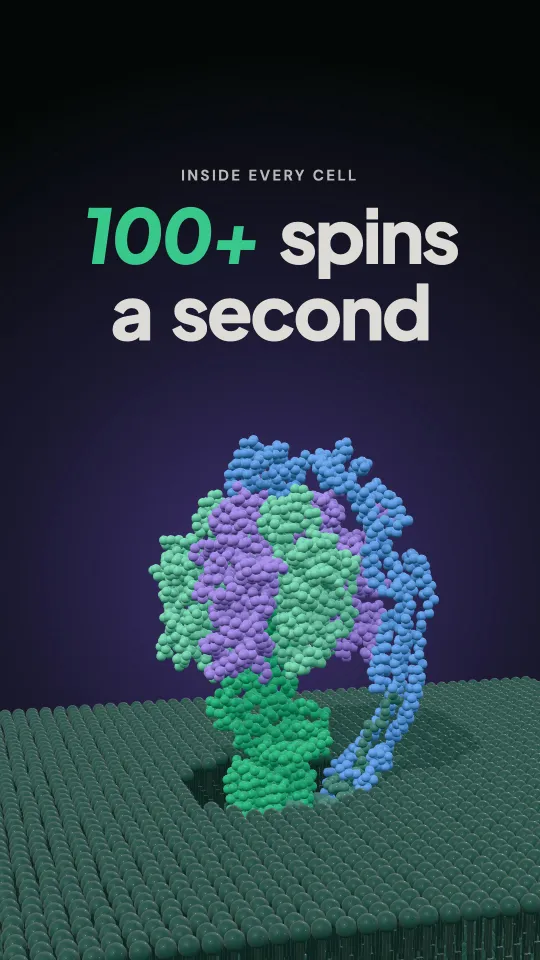
ATP synthase: the spinning motor inside your mitochondria
The last step of making ATP happens in a protein machine in the inner membrane, called ATP synthase. Part of it really rotates, like the rotor of a tiny turbine. In lab experiments, its head section has been clocked at about 130 turns a second (Yasuda et al. 2001). The speed depends on the set-up, and those lab spins ran the motor in reverse, splitting ATP rather than making it.
The human version has been mapped atom by atom (Lai et al. 2023). This model is built from that real structure, one bead per amino acid.
Your body keeps only a little ATP in stock, so it remakes it constantly. A common rule of thumb is that you turn over roughly your own body weight of ATP every day (Törnroth-Horsefield & Neutze 2008). Set your weight to see what that means.
At 70 kilograms, the rule of thumb gives about 70 kilograms of ATP remade a day: nearly 3 kilograms an hour, or close to 50 grams a minute.
For the motor in under a minute, watch the Short There Is a Spinning Motor Inside Your Cells.
Why do mitochondria have their own DNA?
No other part of an animal cell outside the nucleus carries its own genes. Mitochondria do, because they were once independent living things.
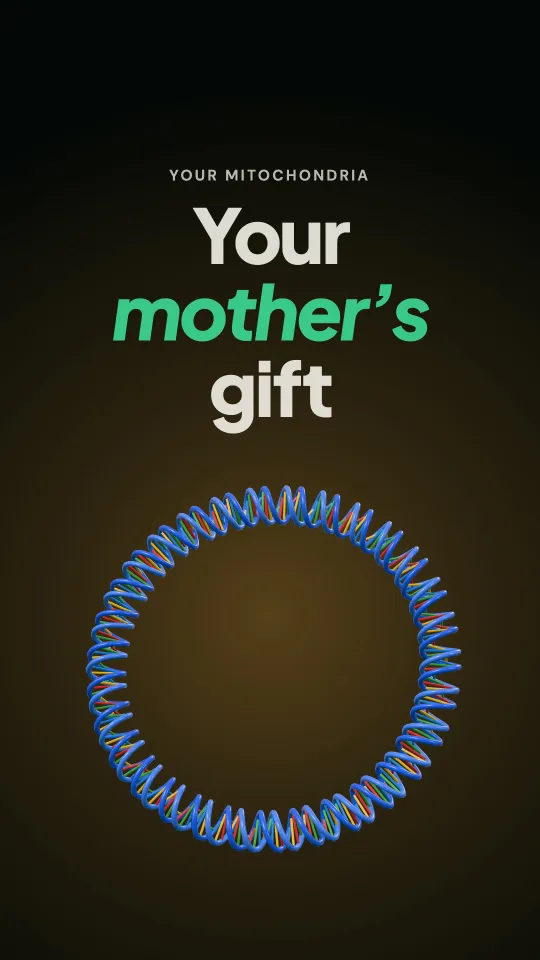
Human mitochondrial DNA was first read in full in 1981 (Anderson et al. 1981). It is a closed ring of 16,569 base pairs, shaped like a bacterium's chromosome. It holds 37 genes: 13 for proteins, 22 for transfer RNAs and 2 for ribosomal RNAs.
That is a tiny fraction of what the original bacterium carried. Over time, most of the tenant's genes moved into the host's nucleus. Today about 1,136 human proteins work inside mitochondria, and all but 13 of them are made from genes in the nucleus and shipped in (MitoCarta3.0, Rath et al. 2021).
Lynn Margulis and the paper 15 journals turned down
In 1967 a young biologist, Lynn Margulis, published a paper arguing that mitochondria were once free-living bacteria. It appeared in the Journal of Theoretical Biology under her married name at the time, Lynn Sagan (Sagan 1967).
Getting it there was hard. She later recalled that the paper “was rejected by about fifteen scientific journals” before the editor James Danielli accepted it (Margulis 1995). The number is her own memory, and no archive confirms it. The story is told in the Short The Idea That Was Rejected Fifteen Times.
The evidence that mitochondria were once bacteria
Her idea won because the clues kept lining up. Pick a clue to compare a mitochondrion with a bacterium.
| Clue | A bacterium | A mitochondrion |
|---|---|---|
| Size | An E. coli cell is about 1 µm wide and 2 µm long | A typical one is about 1 µm wide and 2 µm long |
| Membranes | Its own cell membrane | Two membranes, the inner one bacterial in nature, as if a cell had been swallowed |
| Dividing | Splits in two (binary fission) | Splits in a similar way, and only grows from an existing mitochondrion |
| DNA | A circular chromosome | A circular genome, 16,569 base pairs in humans |
| Ribosomes | Bacterial-type ribosomes | Ribosomes that resemble bacterial ones, not the cell's own |
| Family tree | Alphaproteobacteria are one group among many | Its genes place it closest to the alphaproteobacteria |
The last clue settled it. Once scientists could compare DNA, the family tree put mitochondria right next to the alphaproteobacteria.
When and how did a bacterium move into another cell?
Dating such an ancient event is hard, and studies disagree. One estimate places the origin of alphaproteobacteria at about 1.9 billion years ago and the last common ancestor of all mitochondria at about 1.55 billion years ago (Wang & Luo 2021). Cells with mitochondria are consistently dated to the long stretch between the two great rises of oxygen in Earth's history (Mills et al. 2022).
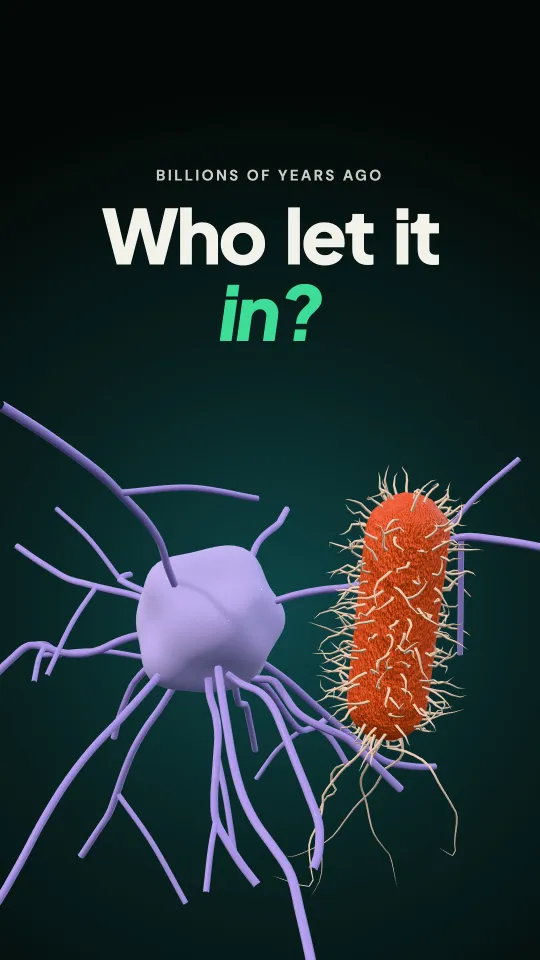
The host was probably not a bacterium at all, but an archaeon, from the other great branch of single-celled life. The leading candidates are relatives of the Asgard archaea. In 2020 a Japanese team grew one in the lab after more than a decade of trying (Imachi et al. 2020). It is a round cell only about 550 nanometres across, with long, often branching arms.
One leading idea is that the partnership started as a trade. The archaeon used hydrogen that the bacterium gave off, and the two grew dependent on each other. Over countless generations they became a single cell: the ancestor of every plant, animal and fungus alive today. Exactly how the first meeting happened is still argued over. The Short The Cell That Let a Bacterium Move In shows the host.
Why do you inherit mitochondria from your mother?
An egg cell is packed with mitochondria. A sperm cell brings a few into the egg too, but they are usually destroyed soon after fertilisation. In mouse embryos this has been watched step by step: the father's mitochondria are tagged and broken down by the cell's recycling system (Rojansky, Cha & Chan 2016).
So your mitochondrial DNA traces back through your mother, her mother, and on along the maternal line.
Is it always the mother? A 2018 study reported three families in which some mitochondrial DNA seemed to come from the father (Luo et al. 2018). A 2020 study of 11,035 families explained that pattern as copies of mitochondrial DNA stored in the father's nuclear chromosomes, and found no evidence of paternal transmission (Wei et al. 2020). Watch Your Mitochondria Came From Your Mother.
Almost always from your mother, with a small debate still open. And every breath you take feeds the descendants of a bacterium that moved in and never left.
Frequently asked questions
Are mitochondria bacteria?
Not any more. They descend from bacteria and still have bacterial features, but they cannot live on their own. Almost all of their proteins are now made from genes in the cell's nucleus.
What is the endosymbiotic theory?
It is the explanation that some parts of complex cells began as bacteria living inside another cell. “Endo” means inside and “symbiosis” means living together. Mitochondria are the best-known case. The chloroplasts that plants use for photosynthesis are thought to have begun the same way.
Do all human cells have mitochondria?
No. Mature red blood cells have none at all. Cells that need a lot of energy, such as liver and muscle cells, can hold hundreds or thousands.
How many genes are in mitochondrial DNA?
In humans, 37 genes on a ring of 16,569 base pairs: 13 code for proteins, 22 for transfer RNAs and 2 for ribosomal RNAs.
How fast does ATP synthase spin?
In lab experiments, part of it has been clocked at about 130 turns a second. That was with the motor running in reverse, and the exact speed depends on the set-up.